
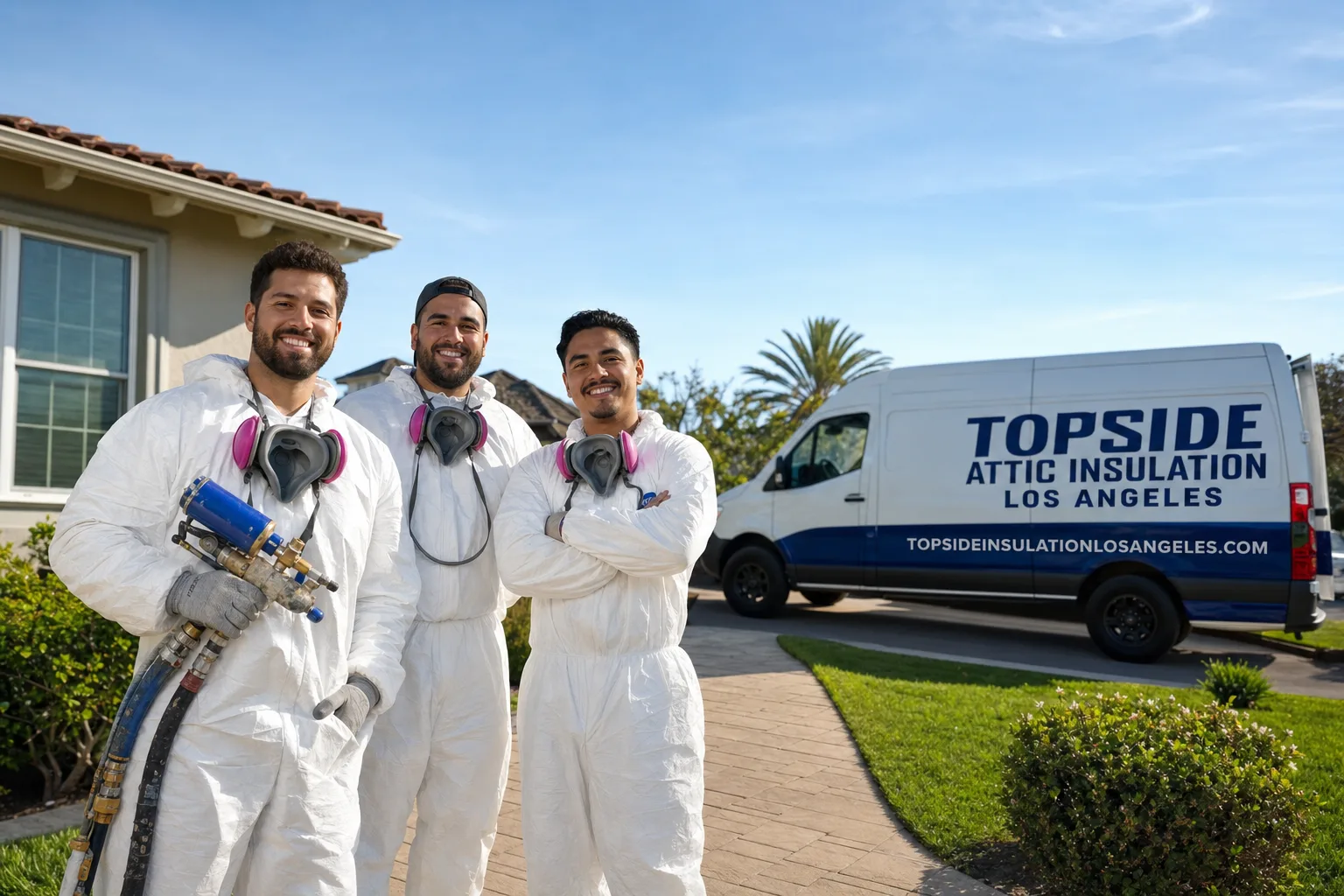
How Much Does Insulation Cost in Los Angeles?
Insulation in Los Angeles typically costs between $1,800 and $6,500 for a standard single-family home, depending on the type of insulation, the area being insulated, and the condition of the existing building envelope. Most attic insulation jobs in a 1,500-to-2,200-square-foot LA home run between $2,200 and $4,800 when proper air sealing is included before the insulation goes in. Spray foam, crawl space encapsulation, and whole-home projects push that figure higher.
If you want a written price for your specific home before anyone touches a thing, call (628) 226-1097 – Wes Okafor’s team at Topside Attic Insulation Los Angeles answers live, 24 hours a day.
Insulation Cost Breakdown (2026)
Insulation prices in Los Angeles run higher than the national average for a few concrete reasons: labor costs, disposal fees for old insulation, and the specific building stock this market has – a lot of older post-war homes in areas like Silver Lake, Leimert Park, and Culver City where attic floors have decades of degraded fiberglass that has to come out before anything useful goes in. The table below reflects what Topside is actually quoting in the Los Angeles market as of 2026, not a national average dressed up with a city name attached.
| Service | Typical LA Price Range | Notes |
|---|---|---|
| Attic insulation (blown-in fiberglass or cellulose) | $1,800 – $3,800 | 1,000-2,500 sq ft attic floor; includes air sealing |
| Attic insulation (batt replacement) | $1,400 – $2,900 | Standard fiberglass batt; less common in retrofit work |
| Spray foam insulation (open-cell) | $2,800 – $6,500 | Roof deck or wall cavities; price per sq ft rises with access difficulty |
| Spray foam insulation (closed-cell) | $4,500 – $9,200 | Crawl spaces, rim joists, unvented roofs |
| Radiant barrier installation | $900 – $2,400 | Stapled to roof rafters; most effective in LA’s high-sun months |
| Attic air sealing (top plates, can lights, penetrations) | $600 – $1,800 | Required before any blown-in work under The Haven Standard |
| Insulation removal and replacement | $2,400 – $5,500 | Includes vacuum removal, disposal, and reinstall |
| Crawl space encapsulation and vapor barrier | $3,200 – $7,800 | Concrete slab homes excluded; heavily variable by crawl depth and moisture |
| Wall insulation (injection foam or dense-pack) | $2,600 – $5,800 | Per full exterior-wall treatment; stucco homes require localized drilling |
| Home energy audit (blower-door test included) | $350 – $750 | Blower-door reading published before and after any sealing work |
What Pushes the Price Up
- Existing insulation that has to come out first. A lot of older Los Angeles homes – particularly Craftsman bungalows in Highland Park and mid-century ranches in the Valley – have compressed, contaminated, or rodent-damaged insulation that has to be vacuumed out before new material goes in. Removal adds $800 to $2,200 depending on depth and debris load.
- Attic access that requires special rigging. Homes in the Hollywood Hills and parts of Echo Park have attics that are barely passable. When the technician can’t stand upright or swing a hose freely, the labor hours go up.
- Air sealing that was skipped by a previous contractor. Blowing insulation over an unsealed attic floor is the single most common installation mistake we document on first visits in Los Angeles. Correcting it – sealing top plates, can-light penetrations, plumbing chases – adds cost but it’s the work that actually changes the blower-door number.
- Spray foam on a complex roof deck. Open-cell foam applied to an unvented roof assembly costs more per square foot when the roof has multiple dormers, valleys, or HVAC equipment sitting in the attic.
What Brings the Price Down
- A home with no existing insulation to remove. New construction or a recently gutted attic is the cleanest starting point and trims the total cost noticeably.
- Simple rectangular attic geometry. A straightforward gable-roof attic with clear access is faster to work in. Faster means lower labor cost.
- California utility rebates. SoCalGas and LADWP both run rebate programs for insulation upgrades – amounts change year to year, but they’ve historically returned $100 to $500 on qualifying projects. Ask about current program status when you’re getting your written price.
What Affects Insulation Pricing in Los Angeles
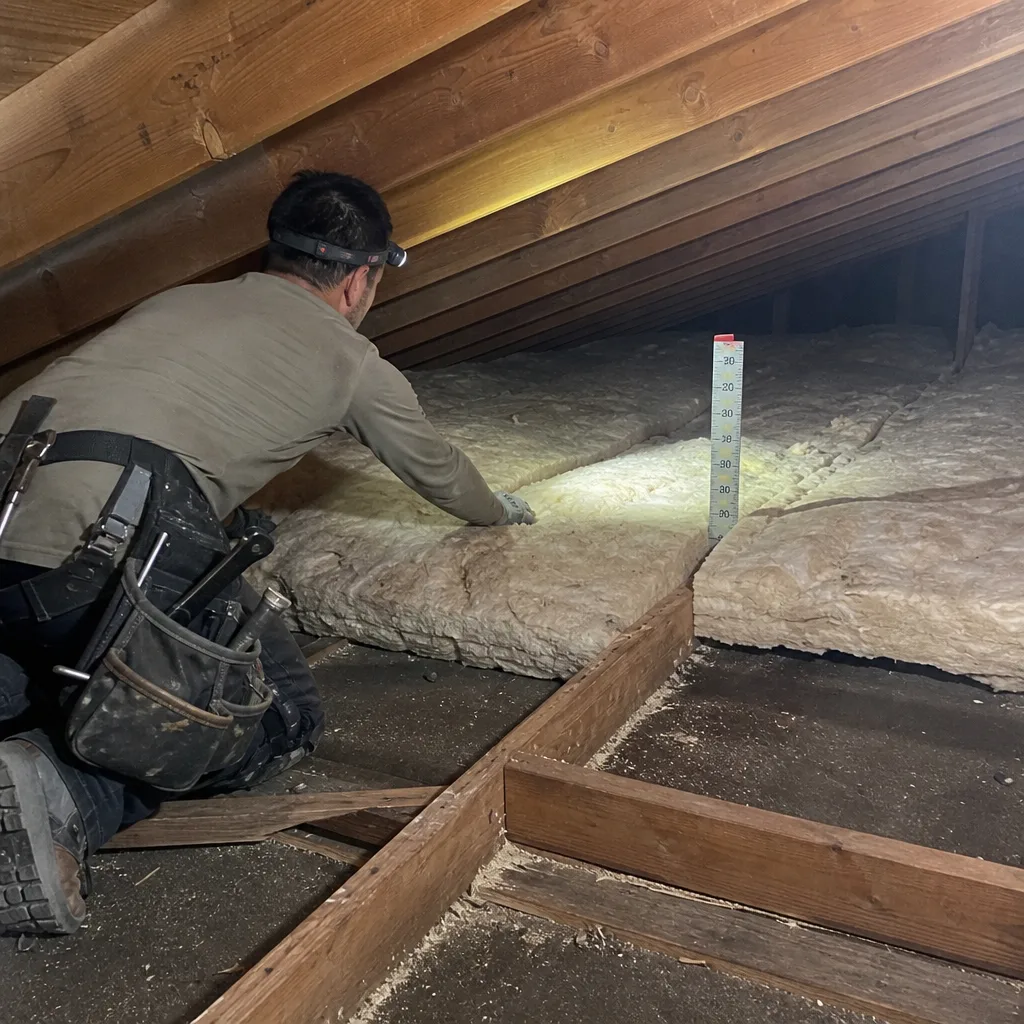
Six factors do most of the work when a written price comes out higher or lower than a homeowner expected. Each one is specific to this market.
- Insulation type and R-value required. California Title 24 sets minimum R-values by climate zone. Most of Los Angeles sits in Climate Zone 9, which calls for R-38 in the attic for a standard home. Getting from R-11 (where many older Koreatown and West Adams homes still sit) to R-38 is a bigger material volume than getting from R-19 to R-38 – that difference shows up directly in the quote.
- Square footage of the area being insulated. This is the most obvious driver and the one contractors sometimes obscure by quoting per-square-foot without specifying what’s included. A 1,000-square-foot attic floor and a 2,500-square-foot one aren’t in the same cost category. Get the total area in writing before comparing bids.
- Whether air sealing is included or omitted. Some contractors in Los Angeles quote insulation-only pricing, leaving air sealing as an optional add-on. The problem is that blown-in insulation over an unsealed attic floor doesn’t perform anywhere near its rated R-value – conditioned air keeps moving through the gaps. At Topside, air sealing of top plates, can lights, and penetrations is completed before any insulation is added, always. That’s the sequence that produces a measurable blower-door improvement.
- Condition of the existing insulation. Rodent activity is common in attic spaces across neighborhoods from Reseda to Boyle Heights. Contaminated insulation has to be removed entirely, and that removal – vacuuming, bagging, hauling – adds significant cost. Attic cleaning and rodent proofing services may also be needed before reinstall.
- Access difficulty. Attic hatch size, crawl height, and the presence of HVAC ducts and equipment all affect how long the crew is in the space. Homes with minimal attic clearance take longer to work in, and that labor difference appears in the price.
- Material choice. Blown-in cellulose (sourced from GreenFiber on our jobs), blown-in fiberglass (Johns Manville and Owens Corning), Rockwool batts, open-cell foam (Icynene or Demilec), and closed-cell foam all land at different price points per square foot. There’s no proprietary product lock-in on our end – the material recommended is the one that fits the application, not the one with the widest margin.
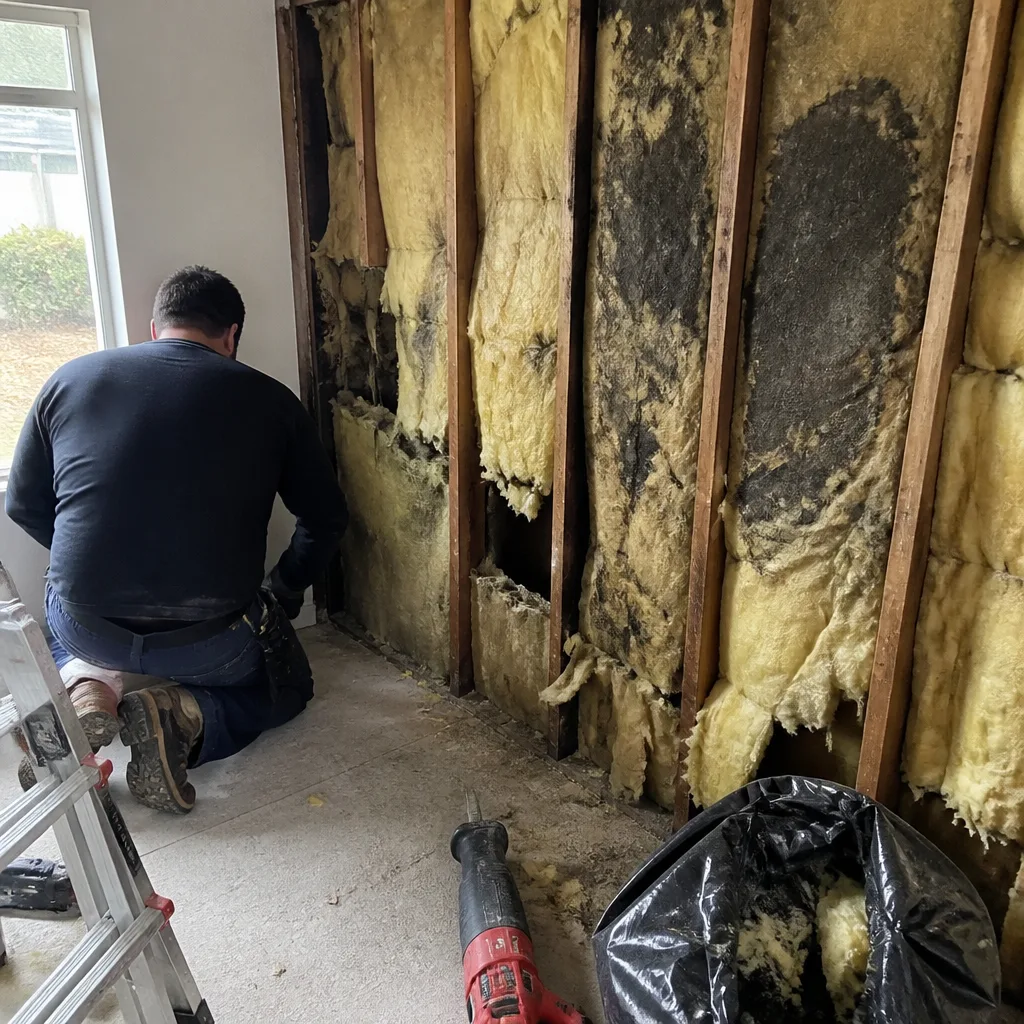 Before
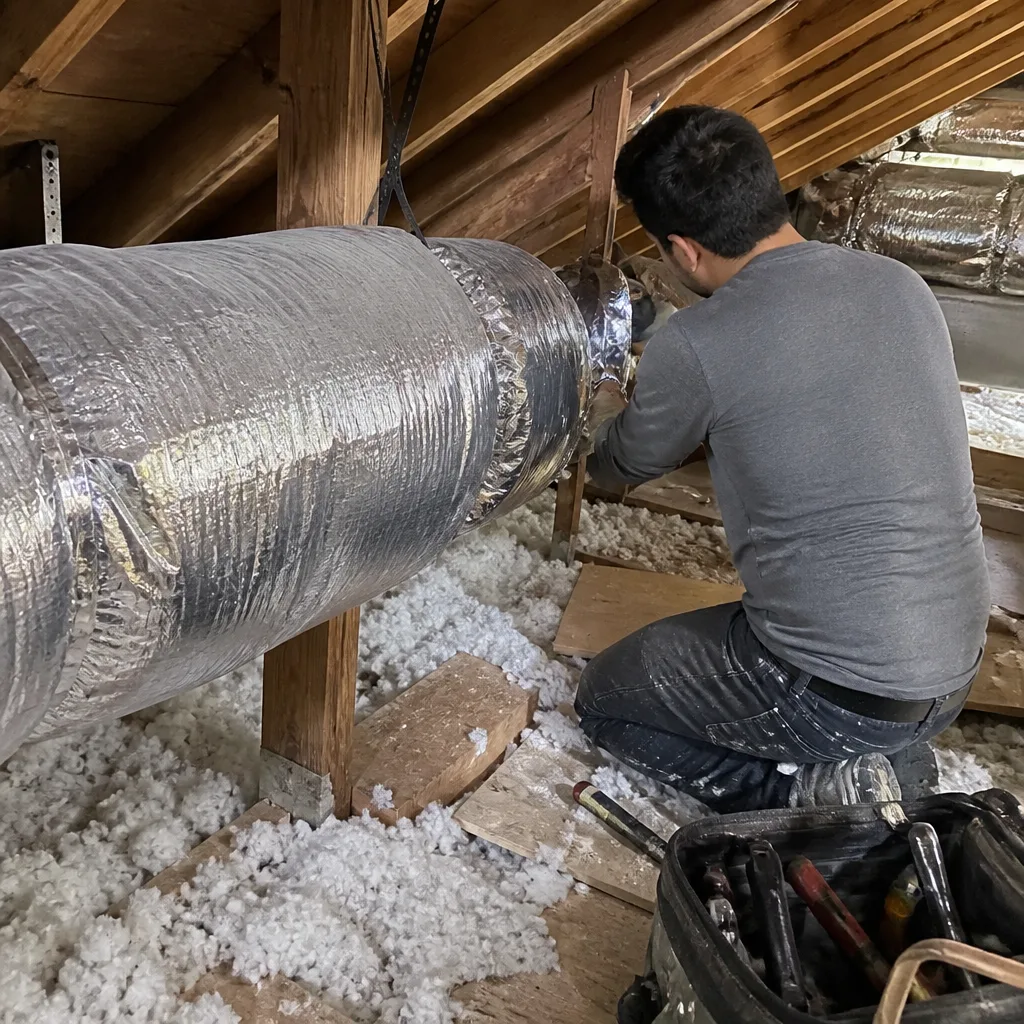 After
AfterLos Angeles-Specific Considerations That Change Your Quote
Los Angeles has a few characteristics that don’t show up on a national pricing guide and that genuinely affect what insulation work costs here.
Climate Zone 9 and Radiant Heat Load
Southern California’s sun angle and the urban heat island effect in dense neighborhoods like Palms, Mar Vista, and North Hollywood mean that radiant heat gain through the roof deck is a bigger problem than it is in most US cities. A radiant barrier – foil material stapled to the underside of the roof rafters that reflects infrared energy before it becomes heat in the attic – is an addition that makes real sense in this climate. It’s not a replacement for insulation, but homes we’ve instrumented in the San Fernando Valley routinely show attic temperatures 20 to 30 degrees lower after radiant barrier installation on a summer afternoon. The cost runs $900 to $2,400 installed, and it pairs well with blown-in insulation on the attic floor.
Title 24 Permit Requirements
For a straight insulation replacement or upgrade without any structural work, Los Angeles County typically does not require a building permit. But if the job involves changes to attic ventilation, work on an unvented roof assembly, or spray foam applied to a conditioned attic, permit requirements can apply. The rules vary by municipality – work in Santa Monica, Pasadena, or Burbank is governed by those cities’ building departments, not the county. A written scope of work, prepared before any job starts, should note which permit category applies so there’s no ambiguity later.
Older Housing Stock
A significant portion of the Los Angeles housing stock was built between 1940 and 1975, before insulation was standard practice and before air sealing was a concept anyone in residential construction was thinking about. In the Crenshaw corridor, in mid-city neighborhoods south of Olympic, and across the eastern San Gabriel Valley, we regularly document attic floors with three inches of flattened, decades-old fiberglass that’s lost most of its R-value and has been colonized by pests. Getting that material out and replacing it properly is almost always the right call, even when removal adds to the initial cost. The efficiency gains show up in the before-and-after blower-door numbers.
How to Save on Insulation in Los Angeles
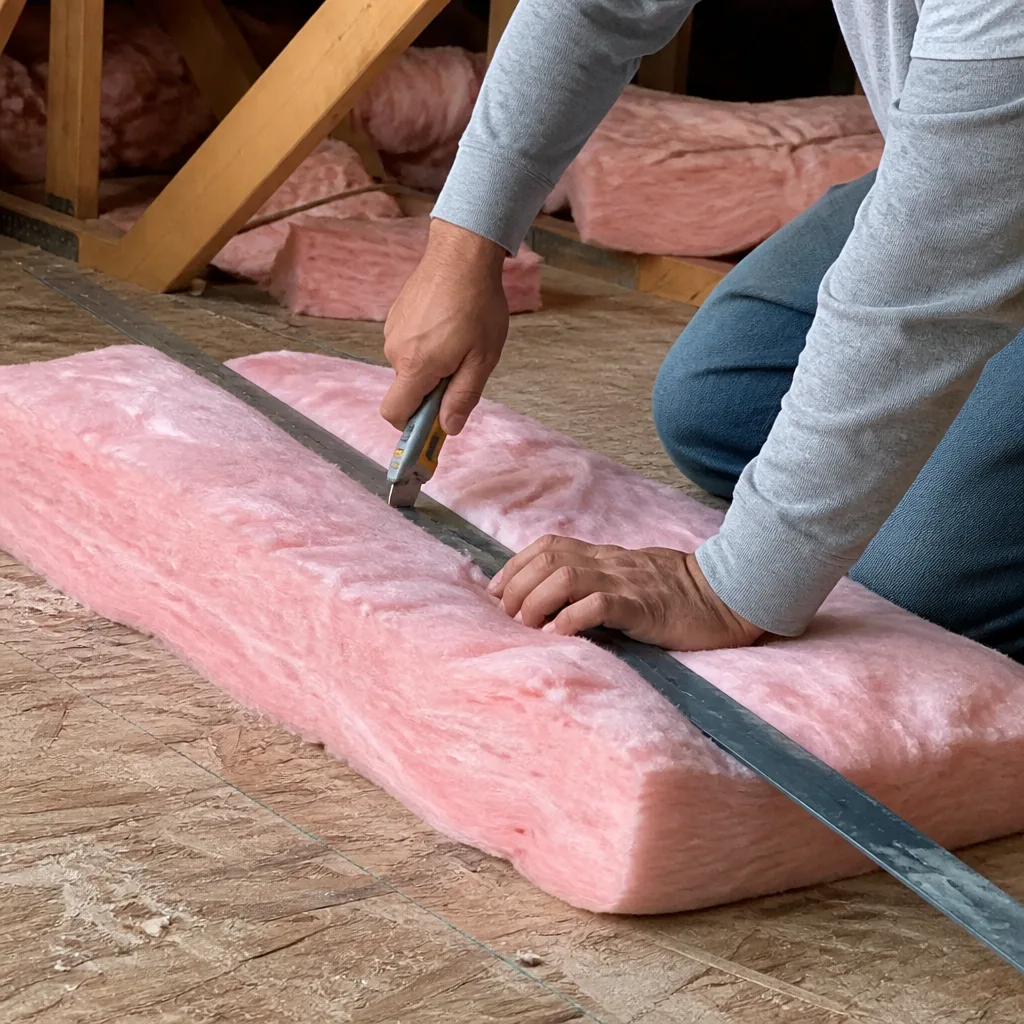
There are real ways to lower the out-of-pocket cost of insulation work in Los Angeles. Some are financial; some are about making sure you’re buying the right scope in the first place.
- Check current LADWP and SoCalGas rebate programs before signing anything. Both utilities have offered rebates on qualifying insulation upgrades – amounts shift year to year based on program funding, but they’ve ranged from $100 to $500 on attic insulation projects. Some programs require a pre-approval before work starts, so timing matters. Ask your contractor to confirm whether your planned scope qualifies before the job begins.
- Get a second opinion on any written estimate before you commit. Topside offers a Free Second Opinion on any written estimate – bring in a competing quote and we’ll read through it with you, line by line, and flag anything that’s missing (like air sealing) or anything that’s being charged at a rate that doesn’t match this market. This isn’t a sales tactic; it’s how we’d want to be treated if we were spending several thousand dollars on work we couldn’t inspect ourselves.
- Don’t skip air sealing to save money upfront. It seems like a cost-saving move to take the insulation-only quote, but the thermal performance you’re paying for doesn’t materialize if the air leaks aren’t sealed first. You’ll have paid for new insulation and still have the energy bill of a leaky house. The blower-door numbers don’t lie about this.
- Ask for a home energy audit before committing to a full scope. A blower-door test – a pressurization reading that shows, in one number, how much conditioned air the building envelope is losing – tells you where the work actually needs to happen. A home that reads 4,500 CFM50 before sealing and 2,200 CFM50 after has cut its air leakage roughly in half. That number helps you prioritize. Topside’s home energy audits run $350 to $750 and the blower-door result is documented before and after any sealing work.
- Bundle services when the crew is already on site. If your attic needs insulation and you have a compromised radiant barrier or suspect rodent damage, doing that work in a single mobilization is cheaper than two separate visits. The truck, the equipment, and the setup time are already there.
- Get a written price before any work starts – and compare it against the actual work order when the job is done. Under Haven Standard Clause 1, every Topside job begins with a flat price, a written scope, and a written warranty before anyone lifts a tool. That written record is also your protection if scope creep becomes a conversation later.
For a written price specific to your home in Los Angeles, call (628) 226-1097. A live person picks up, Wes Okafor’s team can discuss your situation, and you’ll get a documented quote – not a ballpark – before any work is scheduled.
Insulation Types: Which One Is Right for Your Los Angeles Home?
The right insulation material depends on the application, the existing building assembly, and what you’re trying to achieve. Here’s how the main options perform in this specific market.
Blown-In Cellulose
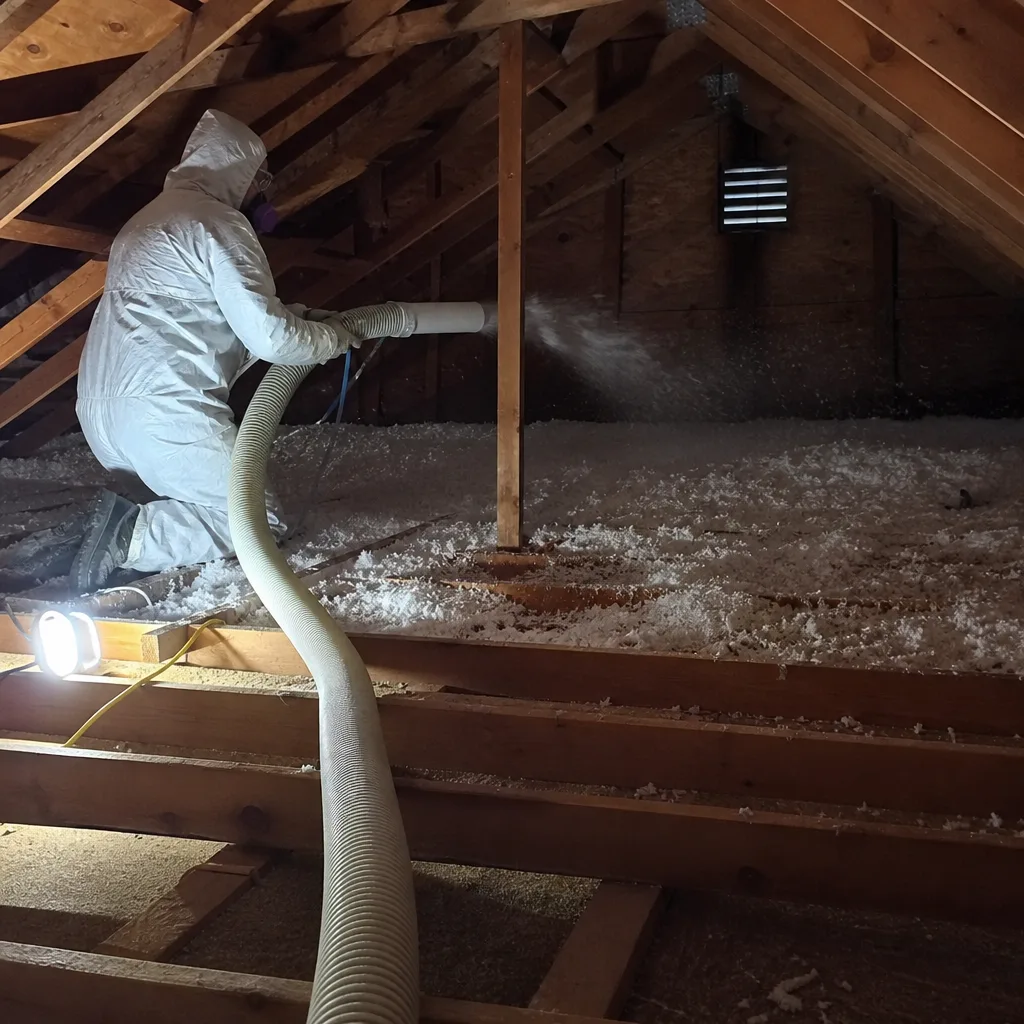
Cellulose – recycled paper fiber treated for fire resistance – is a strong performer on attic floors. It settles into irregular spaces well, has a reasonable R-value per inch (around R-3.7), and is one of the lower-embodied-carbon choices available. GreenFiber is the brand Topside sources for cellulose work. In the Los Angeles market, blown-in cellulose is often the most cost-effective path to reaching R-38 on an attic floor when the substrate is clean and air-sealed.
Blown-In Fiberglass
Fiberglass blown-in (Owens Corning, Johns Manville) performs similarly to cellulose on an attic floor and is slightly more resistant to moisture absorption. In parts of the South Bay and coastal neighborhoods where marine layer moisture is a real factor, fiberglass blown-in is sometimes the better call. It’s also the faster product to install, which affects labor cost on large attic floor projects.
Spray Foam – Open-Cell
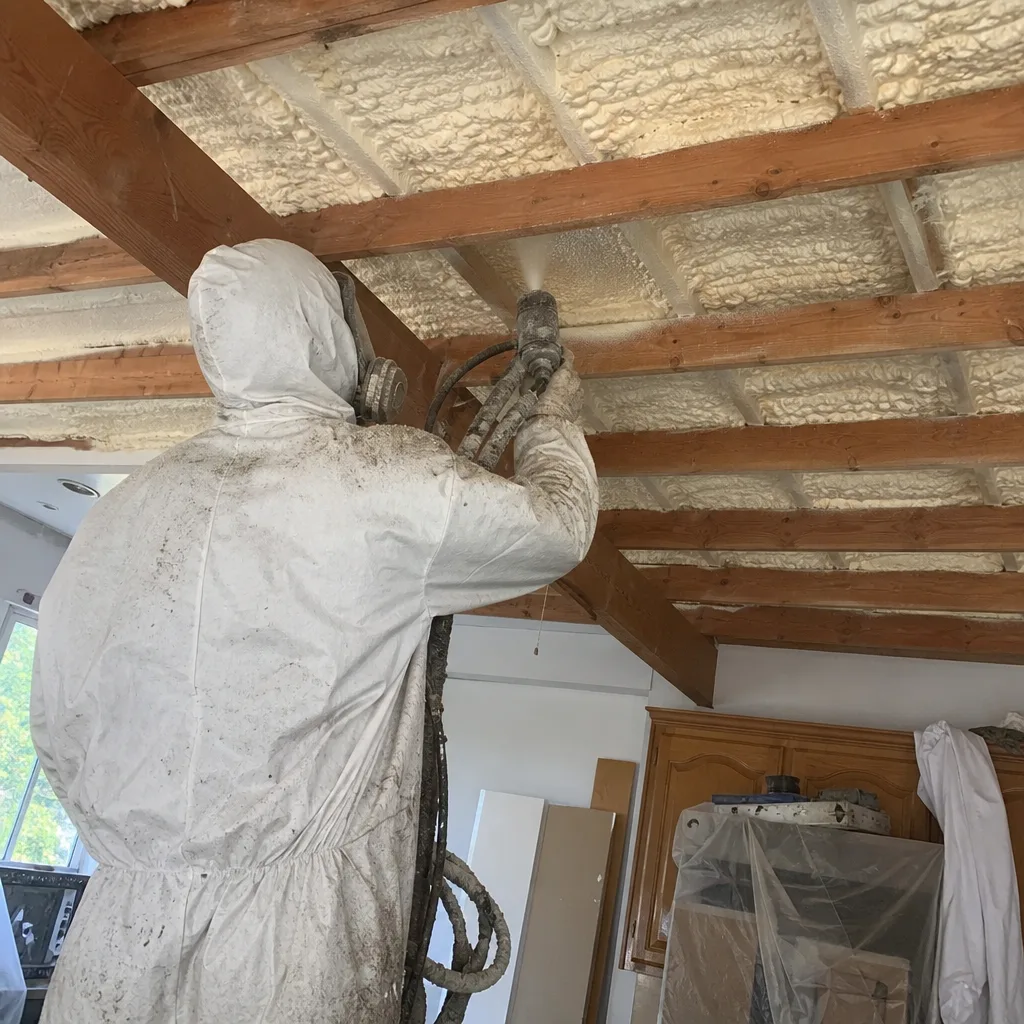
Open-cell foam (Icynene, Demilec) is the right product when you’re insulating an unvented attic assembly – meaning foam applied directly to the underside of the roof deck, creating a conditioned attic space where HVAC equipment lives inside the thermal envelope. It’s significantly more expensive per square foot than blown-in products but delivers a meaningful air-sealing result built into the material itself. Important note: open-cell foam on a roof deck is a structural decision with building science implications, not just an insulation upgrade. It should be paired with a blower-door verification after install.
Spray Foam – Closed-Cell
Closed-cell foam has the highest R-value per inch of any common insulation material (around R-6 to R-7 per inch) and is vapor-impermeable. It’s used on rim joists, crawl space walls, and in applications where moisture control is critical. Cost is the constraint – closed-cell foam runs $4,500 to $9,200 for a full crawl space or unvented roof job in the Los Angeles market.
Rockwool (Mineral Wool) Batts
Rockwool batts from CertainTeed or Rockwool’s own line are the better batt option in situations where fire resistance is a priority – Rockwool is non-combustible – and in new construction or gut-renovated wall cavities where there’s open stud bays to work in. For retrofit work in a finished Los Angeles home, dense-pack or injection foam is usually more practical for wall cavities.
Radiant Barrier
Not an insulation product in the traditional sense, but highly relevant to Los Angeles. A radiant barrier is a foil-faced material stapled to the underside of roof rafters that reflects radiant heat from the roof deck before it conducts into the attic space. In Climate Zone 9, where summer attic temperatures can hit 140 to 150 degrees Fahrenheit on a south-facing roof, a radiant barrier meaningfully reduces the heat load that bulk insulation has to deal with. It works best paired with attic ventilation and blown-in insulation on the floor below.
The Air Sealing Step That Most Los Angeles Contractors Skip
This is worth a direct conversation because it changes the outcome of insulation work more than any other single variable.
When a blower-door test – a pressurization measurement that shows, in one number, how much conditioned air the building envelope is losing – is run on a typical older Los Angeles home before any work, readings in the 3,500 to 6,000 CFM50 range are common. That means the house is exchanging its conditioned air with the outside at a rate that no amount of insulation on the attic floor will fully correct. The air is moving through gaps: at top plates where the ceiling framing meets the wall, around recessed can lights (which are essentially holes in the ceiling with a lightbulb in them), along plumbing and electrical penetrations, and through gaps in interior wall cavities that connect directly to the attic.
Blowing insulation over those gaps adds an R-value on paper. It doesn’t stop the air movement. The blower-door number afterward tells the story – a job that was insulation-only often shows a CFM50 reduction of less than 10%. A job where top plates, can lights, and penetrations were sealed with fire-rated caulk and foam before the blown-in went down routinely shows a 40 to 55% reduction.
At Topside, the sequence is fixed: seal first, then insulate, in that order. Air sealing of top plates, can lights, and penetrations is completed before any insulation is added – it’s not an upsell, it’s the prerequisite. The before-and-after blower-door numbers are published on every applicable job so you can see what changed and verify the work accomplished what it was supposed to accomplish.
This is the core of what you’ll find described across the home at Topside Attic Insulation Los Angeles – a building envelope approach where documentation replaces claims.
What the Written Price and Job Record Actually Contain
Under The Haven Standard – the operating standard Envelope Insulation Co. has run under since 2016 – two documents define every job: the written price before work starts, and the documented record when the crew leaves.
The written price includes a flat price (no range, no “starting at”), a written scope describing exactly what is being done and what materials are being used, and a written warranty. Those three items are delivered before anyone lifts a tool. If the scope changes during the job for a documented reason, a revised written price is issued before the additional work begins.
The job record includes a Documented Photo Record – images of the attic or work area before and after, documenting insulation depth, air-sealing locations, and any site conditions that affected the work. On applicable jobs (any project that included air sealing), before-and-after blower-door readings are included. The CFM50 reading before work started and the reading after are both recorded so the homeowner can see the measurable change.
Wes Okafor built this documentation standard because the alternative – a verbal description of work completed on an invoice with no photos and no performance measurement – leaves the homeowner with nothing to verify against. In a market as active as Los Angeles, where insulation contractors range from highly competent to functionally absent after cashing the check, having a documented record is the only way to know the work was done.
FAQs – Insulation Cost in Los Angeles
How much does attic insulation cost in Los Angeles in 2026?
Attic insulation in Los Angeles runs between $1,800 and $3,800 for most single-family homes when blown-in insulation is installed on the attic floor with air sealing included. A 1,500-square-foot attic floor going from minimal insulation to R-38 (the California Title 24 requirement for Climate Zone 9) typically lands between $2,200 and $3,200 when access is standard and there’s no existing insulation to remove. Removal and replacement – pulling out old degraded material before the new install – adds $800 to $2,200 depending on depth and debris. Call (628) 226-1097 for a written price specific to your home’s square footage and current condition.
Is spray foam insulation worth the cost in LA?
Open-cell spray foam runs $2,800 to $6,500 for a typical Los Angeles application and closed-cell runs $4,500 to $9,200 – both significantly more than blown-in alternatives. Whether the cost is justified depends entirely on the application. Spray foam on an unvented roof deck (where the foam creates a conditioned attic) is the right product for homes where HVAC equipment lives in the attic and you want it inside the thermal envelope. For a vented attic where you’re just trying to hit R-38 on the floor, blown-in cellulose or fiberglass is more cost-effective. The blower-door numbers after both approaches tell the real story – we publish those results on every applicable job.
Does insulation installation require a permit in Los Angeles?
A standard attic insulation upgrade – adding or replacing blown-in insulation on an existing vented attic floor – typically does not require a permit in the City of Los Angeles or in most LA County jurisdictions. Exceptions apply when the work involves changing the attic ventilation configuration, converting to an unvented roof assembly with spray foam, or when the home is in a jurisdiction with specific local requirements (Pasadena, Santa Monica, and Burbank each run their own building departments). A written scope prepared before work starts should note whether any permit is required for your specific project.
How long does attic insulation last in Los Angeles?
Quality blown-in insulation – cellulose or fiberglass – installed in a sealed, pest-excluded attic has an effective life of 20 to 30 years before meaningful settling or R-value degradation becomes a concern. The key variable in Los Angeles is pest intrusion. Attics with rodent access points that haven’t been sealed accumulate contaminated insulation much faster – in some cases, material installed 10 years ago is functionally compromised. A documented photo record from the original installation gives you a baseline to compare against during any future inspection, which is one reason we include it on every job.
Can I get a rebate for insulation in Los Angeles?
Yes. LADWP and SoCalGas both offer rebate programs for qualifying insulation upgrades, and amounts have historically run between $100 and $500 per project depending on the program year, the R-value being added, and whether the home passes a pre-qualification. Some programs require a pre-approval application before work starts – doing the installation first and then applying often disqualifies the project. Confirm current rebate availability and eligibility requirements before your job is scheduled, and make sure the written scope documents the R-value clearly so the rebate application has what it needs.
What is included in a blower-door test, and do I need one before insulation?
A blower-door test is a pressurization measurement – a calibrated fan is mounted in an exterior door frame, the house is depressurized, and the equipment measures how much air (in CFM50, cubic feet per minute at 50 Pascals of pressure) the building envelope is losing. That single number tells you how leaky the house is before any work. In Los Angeles, older homes commonly read between 3,500 and 7,000 CFM50 at baseline. After thorough air sealing, well-executed jobs reduce that reading by 40 to 55%. The test runs $350 to $750 as a standalone home energy audit. On any Topside job that includes air sealing, the blower-door is run before and after, and both readings are documented for the homeowner.
Written by Wes Okafor, Owner at Topside Attic Insulation Los Angeles, serving Los Angeles, CA since 2016.
Pricing reflects the Los Angeles market as of 2026. Topside Attic Insulation Los Angeles offers free estimates – call (628) 226-1097.
What Our Customers Say
"They air-sealed the attic floor before insulating and showed me the blower-door number before and after. The upstairs is finally the same temperature as downstairs."
- Marisol D."They photographed rodent damage in the old insulation that we had no idea about, and priced the exclusion work separately so we could decide."
- Harriet N."The winter gas bill dropped by about a third. They had estimated a quarter, so they under-promised."
- Genevieve R.