
How Much Does Attic Air Sealing Cost in Los Angeles?
Attic air sealing in Los Angeles typically costs between $1,200 and $3,800 for a single-family home, with most jobs in the 1,500-to-2,500-square-foot range landing around $1,800 to $2,600. The wide range comes down to attic size, how many penetrations need sealing, current air-leakage severity, and whether any old insulation needs to be moved or removed before the work can begin.
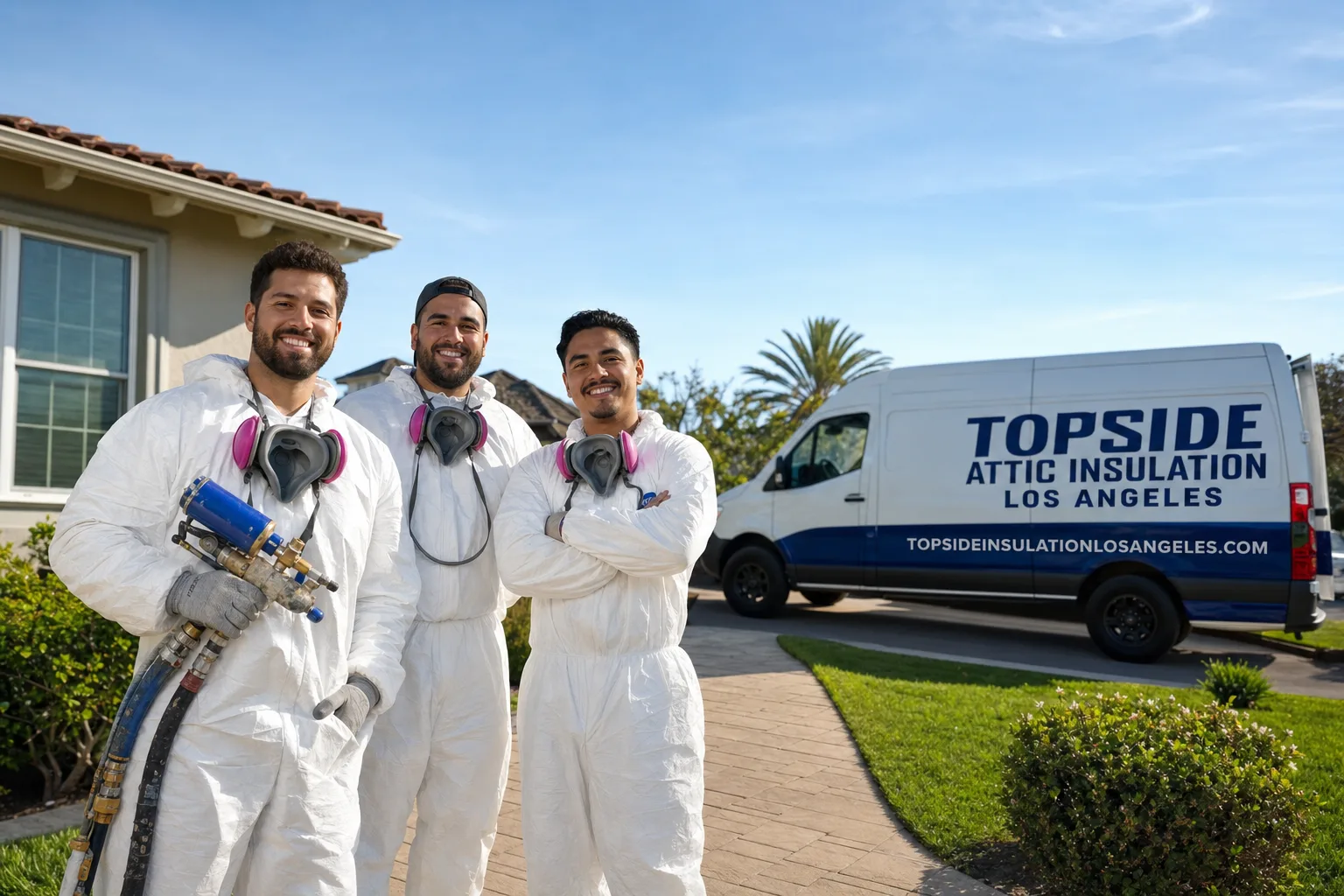
If you want the number before we ever lift a tool, that’s exactly how we work at Topside Attic Insulation Los Angeles – a written price, a written scope, and a written warranty before any crew member enters your attic, every time.
Attic Air Sealing Cost Breakdown (2026)
Attic Air Sealing services in Los Angeles cost $1,200 to $3,800 for most single-family homes. Here is how that number typically breaks down by job type, scope, and attic size:
| Scope / Home Size | Typical Cost Range (Los Angeles, 2026) | What’s Included |
|---|---|---|
| Basic air sealing only – small home (under 1,200 sq ft) | $950 – $1,400 | Top-plate sealing, penetrations, can lights if accessible |
| Standard air sealing – mid-size home (1,200-2,000 sq ft) | $1,400 – $2,200 | Top plates, can lights, HVAC chases, plumbing and electrical penetrations |
| Standard air sealing – larger home (2,000-3,000 sq ft) | $2,200 – $3,200 | Full attic floor coverage, multiple HVAC boots, all penetrations |
| Air sealing + insulation removal and replacement | $3,000 – $5,800+ | Old insulation vacuumed out first, air sealing completed, new insulation added on top |
| Blower-door test (standalone – before/after verification) | $250 – $450 | Pressurization reading in CFM50; before and after readings on sealed jobs |
| Add-on: HVAC chase sealing (per chase) | $120 – $280 | Hard-coat or spray foam sealing of duct chases at attic floor |
| Add-on: recessed can light air sealing (per fixture) | $25 – $60 | Airtight covers or foam detailing around each can light box |
What Pushes the Price Up or Down
The single biggest driver in Los Angeles is attic access and clearance. A 1960s Westwood bungalow with a 30-inch crawl-space attic takes longer to work in than a newer Sherman Oaks two-story with a full walk-up attic – labor cost goes up when technicians are working flat on their backs over blown-in fiberglass. Older construction in neighborhoods like Echo Park, Silver Lake, and Highland Park often has more unintentional penetrations: abandoned plumbing vents, doubled-up framing from old additions, knob-and-tube wiring passages, and misaligned top plates that each need individual attention.
Homes built before 1980 in the San Fernando Valley – especially in Reseda, Canoga Park, and Northridge – frequently have recessed can lights that predate airtight standards. Each one is a direct chimney between conditioned space and the attic. Sealing 30 of them adds $750 to $1,800 to a job that might otherwise be straightforward.
On the lower end, a newer construction home in Playa Vista or Culver City built after 2010 might need only targeted sealing around HVAC penetrations and a handful of top-plate gaps – the original framing was tighter and the can lights were likely specified airtight from the start.
What Affects Attic Air Sealing Pricing in Los Angeles
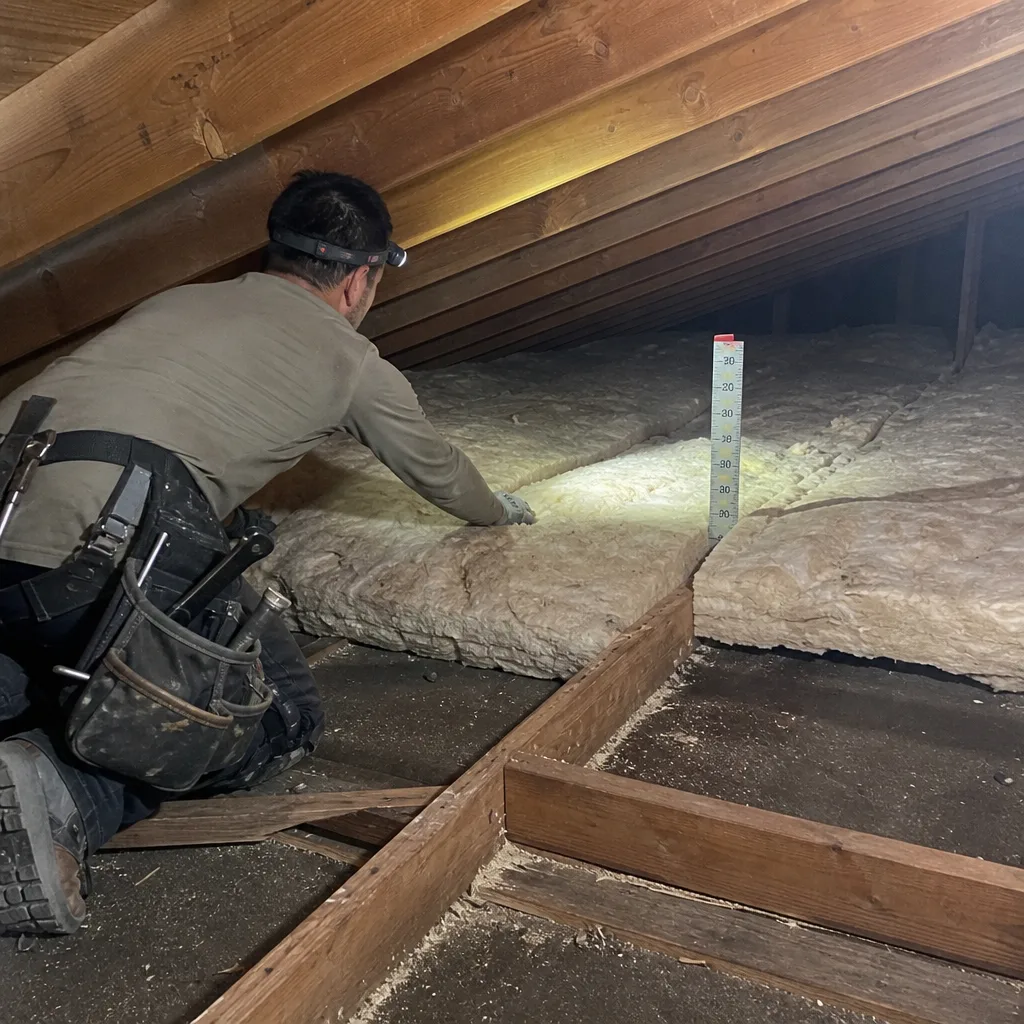
- Attic square footage and geometry: A 2,800-square-foot attic in a two-story Encino colonial has more linear feet of top plate than a 1,400-square-foot ranch in Van Nuys. More top plate means more sealing material and more labor hours. Unusual geometry – multiple roof pitches, knee-wall sections, dormers – adds complexity and time.
- Number and type of penetrations: Every pipe, wire, duct, and exhaust fan that passes through the attic floor is a potential air pathway. Older Los Angeles homes routinely have 40 to 80 individual penetrations in an attic of average size. Each one gets sealed individually – typically with two-part spray foam or fire-rated caulk – and the count is one of the most direct cost levers on any job.
- Existing insulation condition: If the attic floor is already covered in blown-in fiberglass or cellulose, that insulation usually has to be moved or vacuumed back before we can see and seal the top plates. In some cases – particularly in homes in the Crenshaw district or Leimert Park that haven’t had insulation work done since the 1970s – the existing material is so degraded or rodent-contaminated that it has to be removed entirely before air sealing begins. Removal adds cost; it also adds time.
- Access difficulty and attic height: Los Angeles has an unusual mix of housing stock. Spanish Colonial Revival homes in Los Feliz often have low-pitched tile roofs with barely 18 inches of clearance at the attic perimeter. Post-WWII tract homes in the West Adams area can have full-height attics that are far easier to work in. Tight clearances slow the crew down and increase labor costs – the hourly rate isn’t different, but the hours required are.
- HVAC system configuration: Homes with air handlers and ductwork located in the attic – common in single-story San Fernando Valley construction – have additional sealing requirements around duct penetrations, platform framing, and boot connections. A whole-house air handler sitting on an unsealed attic platform can account for a significant fraction of total air leakage. Addressing it properly takes both time and material.
- Fire-rated materials requirement: In areas of Los Angeles with Wildland-Urban Interface (WUI) designations – parts of the Santa Monica Mountains, portions of La Canada Flintridge, and many hillside communities from Topanga to Tujunga – the Los Angeles Department of Building and Safety may require fire-rated sealant materials on certain penetrations, particularly around HVAC and fireplace chases. Fire-rated two-component foam and intumescent caulks cost more than standard materials, and the application process is more involved.
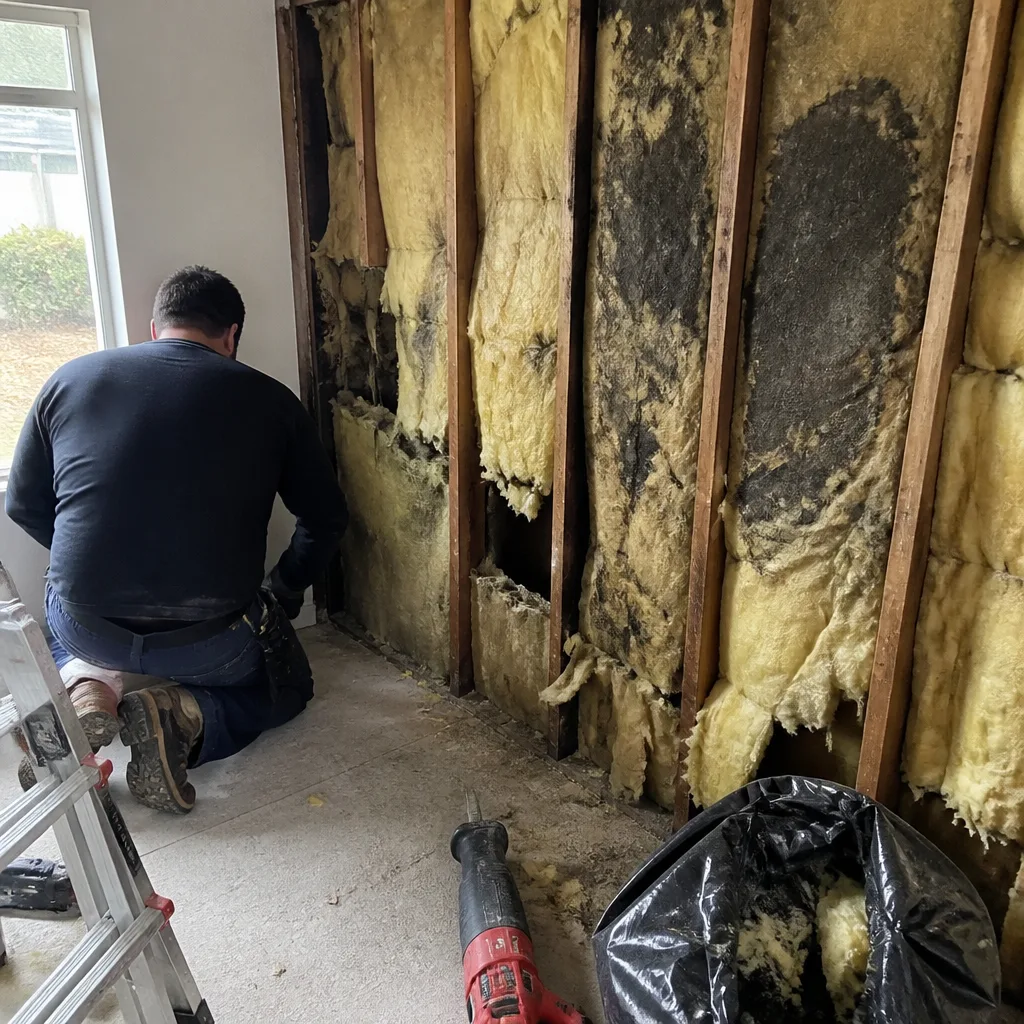 Before
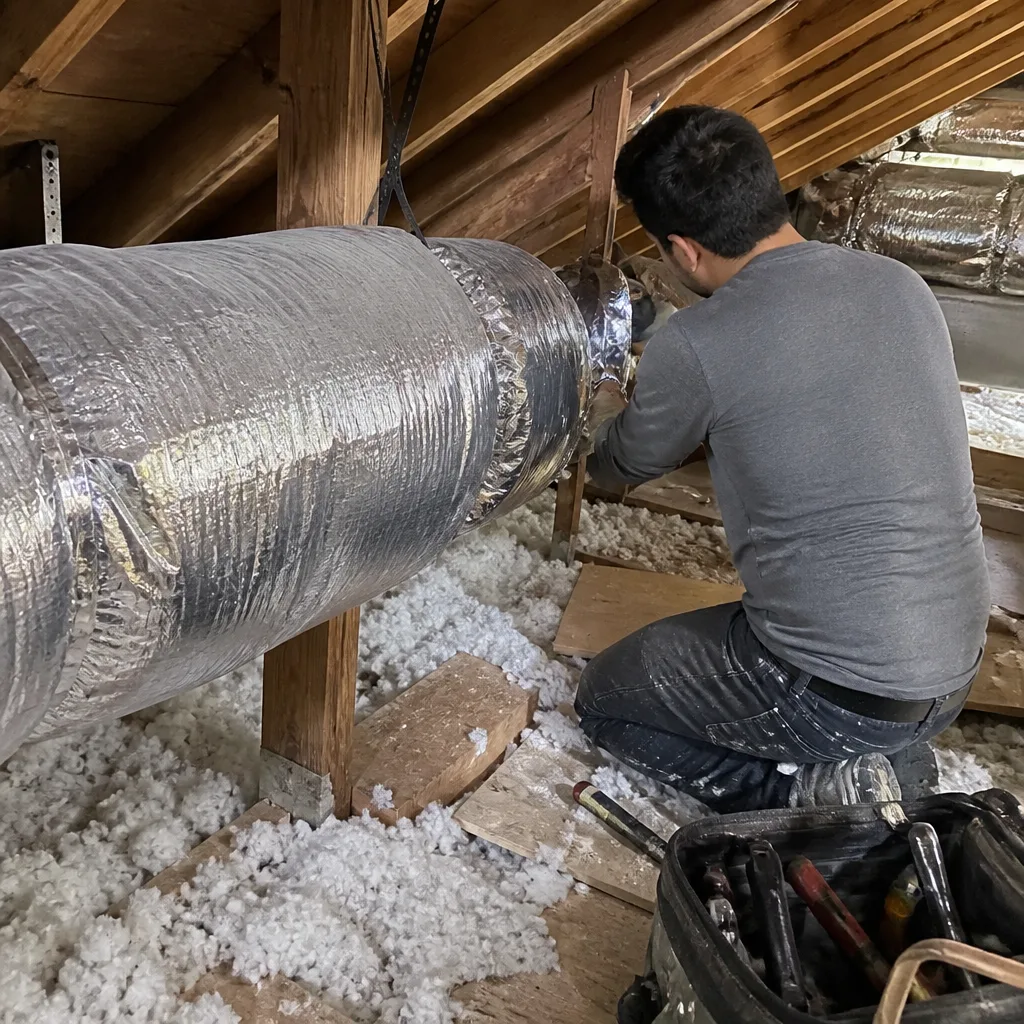 After
AfterHow Attic Air Sealing Actually Works
The goal of attic air sealing is to make the attic floor – not the roof deck – the boundary between conditioned and unconditioned space. Most Los Angeles homes were built with that boundary left wide open: top plates framed in sections with gaps between them, can lights punched through drywall with no airtight box, plumbing vents run through without caulk, electrical wires passing through holes three times larger than the wire.
A proper job starts with a blower-door test – a pressurization reading that measures, in a single number (CFM50, or cubic feet per minute at 50 pascals of pressure), how much air the building envelope is leaking. That number is the baseline. A typical 1,800-square-foot home in Culver City or Mar Vista built in the 1950s might read anywhere from 3,500 to 6,000 CFM50 before work starts. After attic air sealing is complete, that same home routinely reads 1,800 to 3,200 CFM50 – a 30% to 50% reduction driven entirely by work in the attic.
The sealing work itself uses two-part closed-cell spray foam for large gaps (HVAC chases, top-plate gaps over an inch wide, plumbing vents), fire-rated caulk for medium gaps and wire penetrations, and airtight covers or foam detailing for recessed can lights. None of it is complicated in concept. The skill is in finding every pathway – which is where a methodical approach, good lighting, and a blower-door to verify at the end actually matter.
Under the Attic Air Sealing in Los Angeles service we provide, insulation never goes in before air sealing is complete. That sequence matters: insulation added over unsealed top plates still lets conditioned air drive into the attic by convection. The insulation slows conductive heat transfer; it does nothing for air movement. Blowing R-38 cellulose over an unsealed attic floor in a Northridge home feels like the right thing because the R-value sounds good. The CFM50 reading tells a different story.
Los Angeles-Specific Cost Factors Worth Knowing
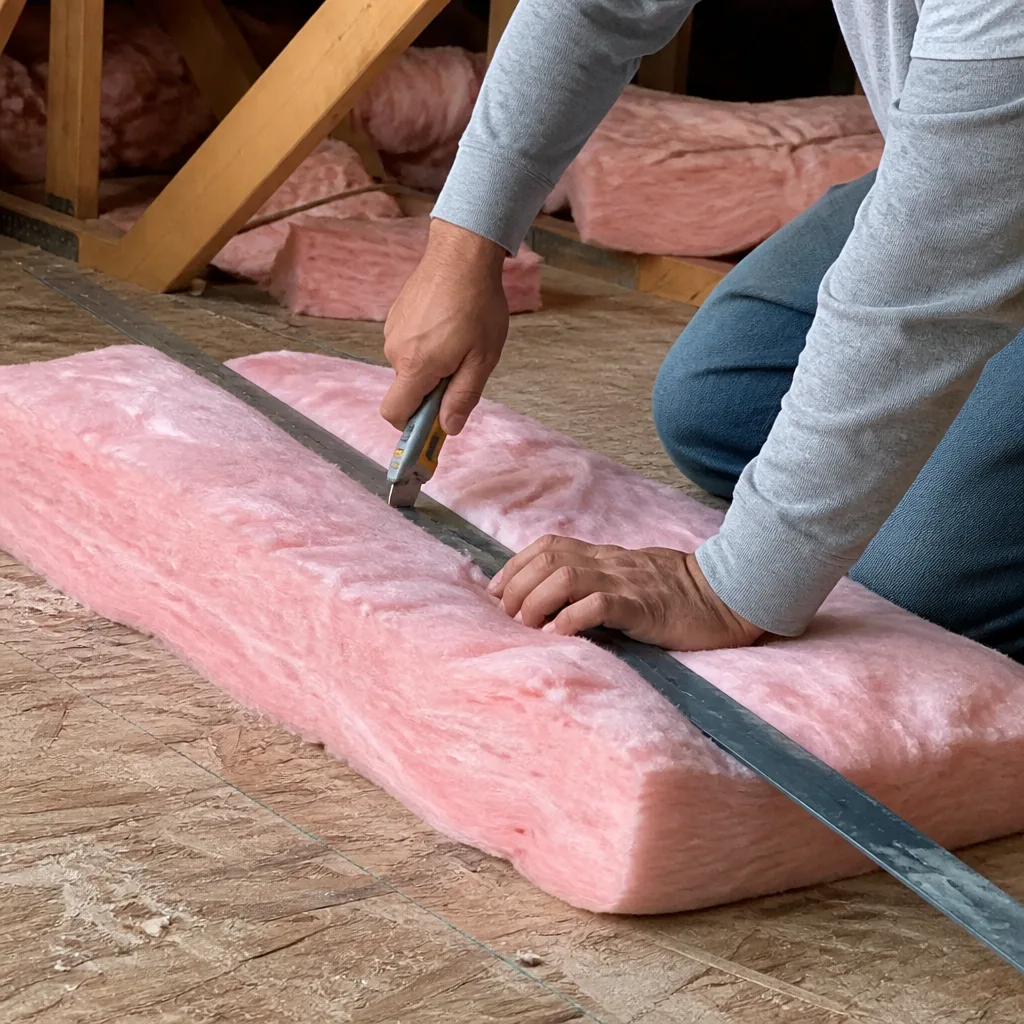
A few things about the Los Angeles market specifically affect what you’ll pay and what you need to check before any work starts.
Permit Requirements
The Los Angeles Department of Building and Safety (LADBS) generally does not require a permit for attic air sealing performed as a standalone service when no structural work, electrical modifications, or mechanical system changes are involved. If air sealing is being done alongside an insulation installation that includes adding new attic ventilation or modifying existing mechanical penetrations, a permit may be required. Homes in WUI zones – which include parts of Pacific Palisades, the Verdugo Hills, and the Arroyo Seco corridor – sometimes have additional requirements tied to roof assembly and attic venting that interact with air sealing scope. When we write the job scope, we identify whether a permit applies and who is responsible for pulling it.
SCE and SoCalGas Rebates
Southern California Edison and SoCalGas both offer weatherization rebates through their Energy Upgrade California programs. As of 2026, air sealing combined with insulation upgrades can qualify for rebates ranging from $200 to $1,500 depending on verified energy savings (typically documented via a blower-door test pre- and post-work). The rebate amount is based on demonstrated performance change, not on what was installed – which is one reason before-and-after blower-door numbers matter beyond the paperwork. A contractor who doesn’t document the starting and ending CFM50 can’t support a rebate claim on your behalf.
Climate Zone Considerations
Los Angeles spans multiple IECC climate zones, but most of the residential footprint sits in Climate Zone 3 or Zone 6 (the higher elevations of the San Gabriel Valley and parts of the Antelope Valley). The minimum R-value requirements for attic insulation and the air-leakage thresholds that trigger code compliance differ between these zones. For homeowners in Altadena, Monrovia, or La Crescenta, this means the insulation component of a combined air sealing and insulation job may require more material to hit code than the same-sized job in Inglewood or Hawthorne. The air sealing scope itself doesn’t change much – every top plate gap is sealed regardless of climate zone – but understanding this prevents the surprise of a higher-than-expected insulation bill on the same project.
How to Save on Attic Air Sealing in Los Angeles
There’s no theatrical way to say this: the biggest savings come from doing the job in the right order and not redoing it. Homeowners who get insulation blown in before air sealing is complete often end up paying twice – once to vacuum out the insulation so the top plates can be accessed, and again to have it reinstalled. In a 2,000-square-foot Reseda home, that sequence error adds $800 to $1,600 in avoidable cost.
A few specific ways to reduce what you pay:
- Bundle air sealing with insulation in a single visit. Scheduling both services together eliminates mobilization costs (typically $150 to $300 per visit) and means the crew only has to clear and reset the attic once. A combined air-sealing-and-insulation job in a 1,800-square-foot Mar Vista home that might cost $2,200 for sealing and $2,800 for insulation separately often comes in at $4,400 to $4,800 as a bundled project.
- Verify rebate eligibility before booking. SCE and SoCalGas rebates require pre-work enrollment in some cases. Confirming your eligibility before scheduling – and making sure your contractor documents CFM50 before and after – can reduce your net out-of-pocket cost by $200 to $1,500 depending on the verified improvement.
- Get a second opinion on any written estimate. We offer a free second opinion on any written estimate from another contractor. That means if you have a competing quote in hand, we will read it with you, identify what it does or doesn’t include, and give you our own written price for comparison. That comparison is free and there’s no obligation – it’s part of how the Haven Standard works in practice.
- Don’t over-scope before seeing a blower-door result. Some contractors quote whole-attic spray foam without first running a blower-door test. Spray foam is appropriate for specific applications – HVAC chases, large framing gaps, and certain WUI-adjacent sealing requirements – but using it across an entire attic floor when targeted sealing with two-part foam and caulk would achieve the same CFM50 reduction is expensive and unnecessary. The data from the test drives the scope; the scope shouldn’t be written before the test.
- Address existing insulation conditions first. If you suspect rodent activity or significant insulation degradation – both common in older homes in the Crenshaw district, Boyle Heights, and parts of South LA – dealing with removal before air sealing avoids a second mobilization. Removing contaminated insulation before sealing is cheaper than removing it after fresh sealant has been applied over it.
To get a written price for your specific attic before any work starts, call (628) 226-1097. Estimates are free and the price we give you in writing is what you pay – no adjustments after the crew arrives.
FAQs – Attic Air Sealing Cost in Los Angeles
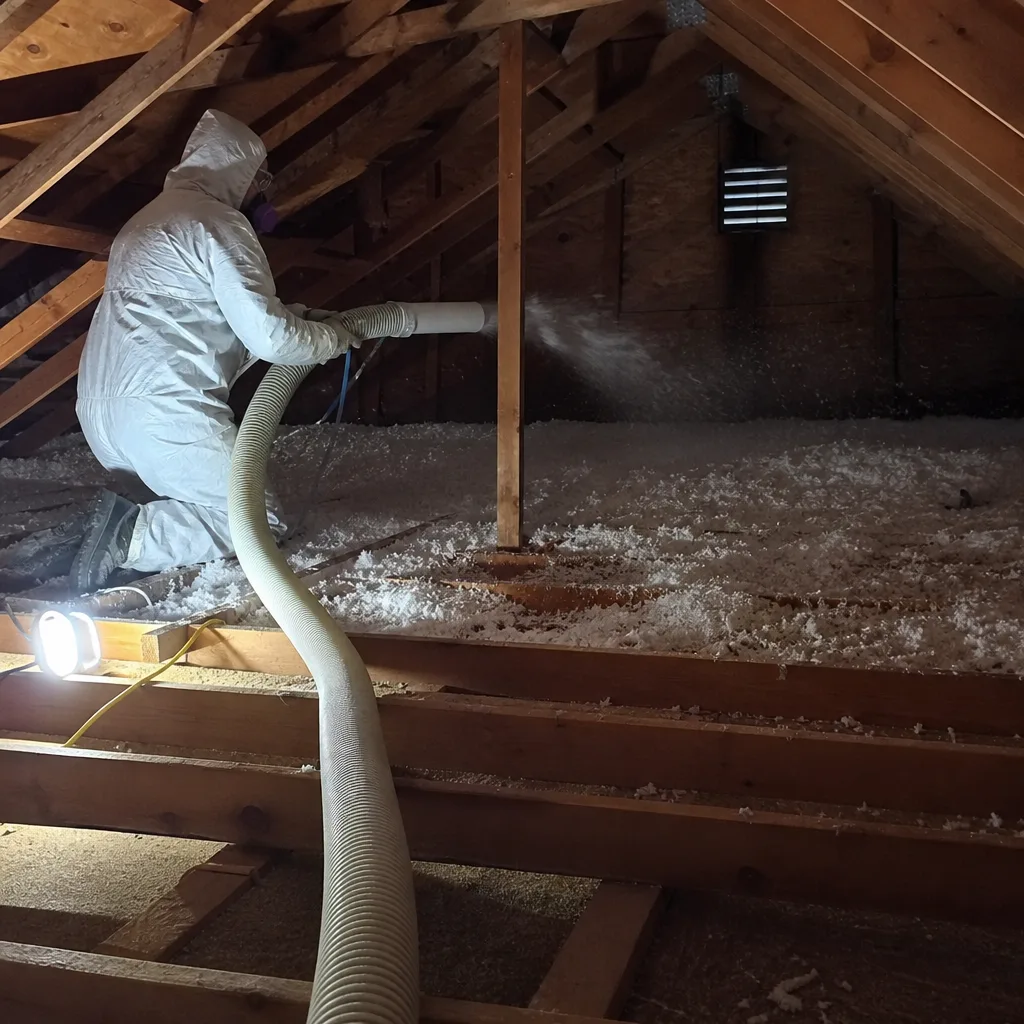
How much does attic air sealing cost in Los Angeles?
Attic air sealing in Los Angeles costs $1,200 to $3,800 for most single-family homes, with the majority of mid-size jobs (1,200 to 2,500 square feet) coming in between $1,600 and $2,800. Smaller homes and condos with limited attic penetrations can come in under $1,200; larger homes with many can lights, HVAC chases, and complex framing can exceed $3,800, especially when paired with insulation removal. Call (628) 226-1097 for a written price on your specific home – estimates are free and you get the number before we start.
Is attic air sealing worth the cost in a Los Angeles climate?
Yes – and the blower-door numbers make the case more clearly than any general claim can. In a typical mid-century Los Angeles home with unaddressed top plates and original recessed can lights, a pre-sealing blower-door test often reads 3,500 to 5,500 CFM50. After sealing, that same home typically reads 1,800 to 3,000 CFM50 – a 35% to 45% reduction in air leakage. In a Los Angeles climate where air conditioning runs hard from May through October, that reduction translates directly to lower runtime on your system. Homes in the Inland Empire fringe – Pomona, El Monte, Baldwin Park – where summer temperatures push past 100°F regularly, tend to see the most immediate bill impact. The SCE and SoCalGas rebate programs exist because the energy agencies have already run the math on this.
How long does attic air sealing take?
Most attic air sealing jobs in Los Angeles take 4 to 8 hours for a single-family home, with one crew typically completing the work in a single visit. A smaller home under 1,500 square feet with straightforward attic access – common in parts of Inglewood, Hawthorne, and Torrance – often finishes in 4 to 5 hours. Larger or more complex attics in homes above 2,500 square feet, or attics with significant existing insulation that needs to be carefully moved and replaced, can take a full day. When air sealing is combined with insulation installation in a single visit, plan for a 6-to-10-hour window depending on scope.
Can I do attic air sealing myself to save money?
The sealing materials themselves – canned spray foam, acoustical caulk, rigid foam board – are available at hardware stores. But attic air sealing done without a blower-door baseline is effectively guesswork: you won’t know where the actual leakage pathways are or whether the work you did moved the number. In homes with HVAC equipment, gas flues, or combustion appliances in or near the attic, improper sealing of certain penetrations can also affect combustion air supply and create safety issues. We’d say: sealing a handful of obvious penetrations around a new light fixture or a plumbing vent yourself is low-risk. Treating your attic floor as a whole-envelope air barrier without measurement and without knowing which penetrations require fire-rated material is a different proposition. A starting blower-door reading costs $250 to $450 and tells you what you’re dealing with before you spend a weekend in the attic not moving the number.
Does attic air sealing qualify for rebates or tax credits in Los Angeles?
Yes, on both counts. Southern California Edison and SoCalGas offer rebates through the Energy Upgrade California program; the rebate amount is based on verified air-leakage reduction documented via before-and-after blower-door tests, and can range from $200 to $1,500 for qualifying projects. At the federal level, the Inflation Reduction Act’s Section 25C tax credit covers air sealing as part of a weatherization project at 30% of cost, up to $1,200 per year (as of 2026 – confirm with a tax professional for your situation, since these provisions have been subject to legislative changes). The practical takeaway: a job that costs $2,200 out of pocket could net to $800 to $1,100 after a $400 SoCal utility rebate and a partial federal credit. That math requires proper documentation – specifically, a contractor who records the CFM50 before and after, which is included on every applicable job we complete.
What’s the difference between air sealing and adding more insulation?
Insulation slows the conductive transfer of heat through a surface – it works by resistance. Air sealing stops conditioned air from physically moving through gaps, which is a different problem. A home with R-38 insulation but unsealed top plates is still losing conditioned air every time the HVAC runs because warm or cool air convects through the insulation and exits through the unsealed framing gaps above. Adding more insulation to that attic improves the R-value on paper; it does nothing for the CFM50 reading on the blower-door. That’s why we complete air sealing before insulation goes in – the sequence isn’t a preference, it’s the only order that makes the insulation perform the way its R-value implies it should.
Key Takeaways
- Attic air sealing in Los Angeles costs $1,200 to $3,800 for most single-family homes; mid-size jobs typically run $1,600 to $2,800.
- The main cost variables are attic size, number of penetrations, access difficulty, and whether existing insulation needs to be moved or removed first.
- A before-and-after blower-door test (CFM50 reading) is the only objective way to confirm the work performed as expected – without it, you have no baseline.
- SCE and SoCalGas rebates can reduce net cost by $200 to $1,500; the federal Section 25C credit can add another 30% back on qualifying projects.
- Air sealing must be completed before insulation is installed – not after. Doing it out of order adds cost and doesn’t produce the performance improvement either service is meant to deliver.
- Every job at Envelope Insulation Co. (operating as Topside Attic Insulation Los Angeles) begins with a written price and ends with a documented photo record and, on applicable jobs, before-and-after blower-door readings.
- The 365-Day Done Right Promise applies to all completed work – if it’s not right, we make it right, in writing.
Ready to Get a Written Price for Your Attic?
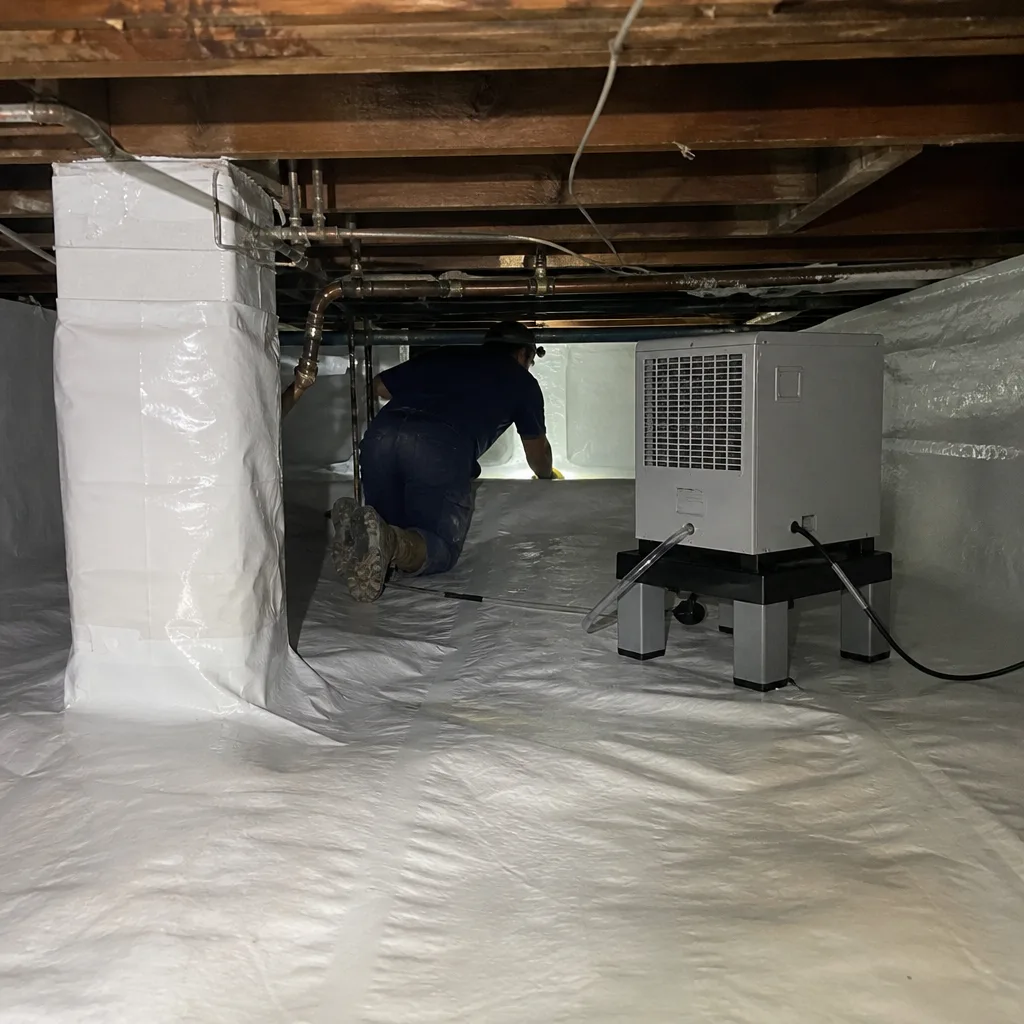
If you want to know what attic air sealing will cost for your specific home in Los Angeles before anyone sets foot in your attic, call (628) 226-1097. The estimate is free. You’ll get a flat price, a written scope, and a written warranty before any work starts – that’s Haven Standard Clause 1, and we don’t make exceptions to it. If you already have a written estimate from another contractor, bring it. We’ll read it with you and give you our own written price for comparison, at no charge.
Wes Okafor and the team at Topside Attic Insulation Los Angeles have been doing this work since 2016. Every job gets a documented photo record. Every applicable job gets before-and-after blower-door numbers. And every quote is written before anyone starts.
Written by Wes Okafor, Owner at Topside Attic Insulation Los Angeles, serving Los Angeles, CA since 2016.
Pricing reflects the Los Angeles market as of 2026. Topside Attic Insulation Los Angeles offers free estimates – call (628) 226-1097.
What Our Customers Say
"They photographed rodent damage in the old insulation that we had no idea about, and priced the exclusion work separately so we could decide."
- Harriet N."The winter gas bill dropped by about a third. They had estimated a quarter, so they under-promised."
- Genevieve R."Fixed price, clean work, and they hauled the old material away as agreed."
- Todd M.